


Snapmaker × Phaetus® Liber™ High Flow Hotend for U1
$125.15
$125.15
$125.15
About this item
Product Feature
Up to 87% Higher Volumetric Flow
Liber™ split-flow technology optimizes the melt path for faster, more efficient extrusion without increasing energy consumption.
Up to 51.98% Faster Printing
High-flow performance significantly reduces printing time on large, continuous-extrusion models. In the listed test, printing time dropped from 7h 59min to 3h 50min.
DLC-Coated Hardened Steel Nozzle
Hardened steel with DLC coating improves surface hardness and wear resistance, helping extend nozzle life during demanding printing.
Ultra-Smooth, Clog-Resistant Filament Path
A precision-machined seamless heat break with Ra ≤ 0.2 μm inner-surface roughness reduces filament adhesion, residue, leakage, and clogging.
Reliable Print Quality at High Speed
Efficient melting and consistent extrusion help maintain interlayer adhesion, fine surface details, bridging performance, and overall print quality even at higher speeds.
Authencity Guaranteed
We only sell authentic products from verified brand partners and retail partners globally.


Liber™was developed by Phaetus and is manufactured by Runice Co., Ltd. It carries the FlowCore™ mark, which identifies products manufactured under licence to the patents published at flowcoreip.com.


Notes
【1】Under laboratory test conditions, printing speed increased by 87%. Test parameters: ambient temperature 24°C; heated bed temperature 100°C; material: Snapmaker ABS; nozzle temperature 280°C; acceleration 1000 mm/s²; single wall; layer height 0.2 mm; spiral vase mode; enclosed printing. The control group was the stock stainless steel hotend tested under the same conditions. Actual results may vary depending on model selection, test environment, and filament differences.
【2】 Liber™was developed by Phaetus and is manufactured by Runice Co., Ltd. It carries the FlowCore™ mark, which identifies products manufactured under licence to the patents published at flowcoreip.com.
【3】 Under laboratory test conditions, printing time was reduced by 51.98%. Test parameters: SnapSpeed PLA; nozzle temperature 220°C; heated bed temperature 55°C. The control group was the stock stainless steel hotend tested under the same conditions. Actual results may vary depending on the test environment and filament differences.
【4】 Test parameters:
SnapSpeed PLA (printing temperature: 220°C; 0.4 mm nozzle; acceleration: 10000 mm/s²; single wall; layer height: 0.2 mm; spiral vase mode)
Snapmaker ABS (printing temperature: 280°C; 0.4 mm nozzle; acceleration: 10000 mm/s²; single wall; layer height: 0.2 mm; spiral vase mode; enclosed printing)
Snapmaker PETG HF (printing temperature: 255°C; 0.4 mm nozzle; acceleration: 10000 mm/s²; single wall; layer height: 0.2 mm; spiral vase mode)
【5】The Liber High Flow Hotend features a DLC-coated hardened steel nozzle. The DLC coating has a surface hardness of approximately HV 2000, while the hardened steel substrate has a hardness of approximately HV 725-780. These two values refer to the coating and substrate, respectively, and do not represent the overall hardness of the nozzle. In comparison, the U1 stock stainless steel nozzle substrate has a hardness of approximately HV 170-210. The DLC coating further enhances the surface hardness and wear resistance of the Liber High Flow Hotend nozzle.
【6】 Ra ≤ 0.2 μm represents the typical roughness control level measured at multiple points under standard processing conditions; the local single-point roughness limit is Ra ≤ 0.4 μm. Lower inner-wall roughness helps reduce filament travel resistance and the risk of material adhesion and clogging. Measurement locations, sampling lengths, and evaluation methods follow the established inspection specification. Results may differ when other measurement methods or standards are used.
【7】The comparison images are based on laboratory testing under the following conditions: ambient temperature: 24°C; bed temperature: 65°C; filament: SnapSpeed PLA; nozzle temperature: 220°C; retraction speed: 30 mm/s; retraction length: 1.2 mm. Reference results were obtained using other high flow hotends under the same conditions. Actual results may vary depending on the testing environment and filament used.
【8】 The comparison images are based on laboratory testing under the following conditions: ambient temperature: 24°C; bed temperature: 55°C; filament: SnapSpeed PLA; nozzle temperature: 220°C; acceleration: 10,000 mm/s². Reference results were obtained using other high flow hotends under the same conditions. Actual results may vary depending on the testing environment and filament used.
Product specifications
What's In The Box (4-Pack)

Individual Boxes x 4
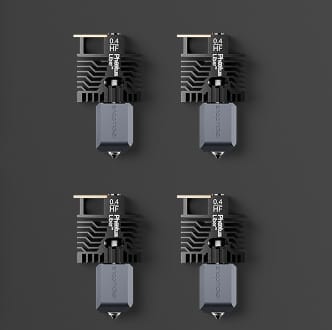
0.4 mm Hotend Assembly(with Thermistor) x 4
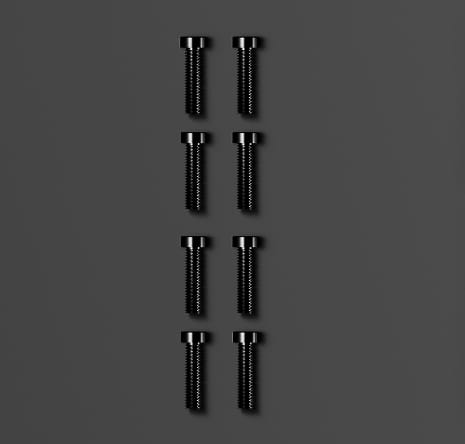
Screws (M3*12) x 8

Wiki Cards x 4
Important Notes
- The High Flow Hotend is best suited for printing large models with long, continuous extrusion paths, where its high-speed, high-flow capabilities can be fully utilized. For models with intricate details, complex curved surfaces, numerous corners, or frequent changes in direction, printing speeds may be limited, and the benefits of the High Flow Hotend may be less noticeable.
- The U1 currently does not support using hotends with different nozzle diameters in the same print job. Before printing, ensure that all toolheads used in the print job are equipped with hotends of the same nozzle diameter.
- For hotend installation instructions, refer to the U1 Hotend User Guide.
- When switching from high-temperature filaments, such as ABS, ASA, PA, or PC, to heat-sensitive filaments, such as PLA or PETG, perform a cold pull before printing to help prevent clogging. Use the printer's unloading procedure to unload the high-temperature filament, then load the new filament without starting the loading procedure. Set the nozzle to the high-temperature filament's printing temperature and manually extrude until the residual filament is fully purged and the new filament flows smoothly. Lower the nozzle temperature to 220-240°C and continue extruding as it cools. Then lower it to 85°C and, once cooled, slowly pull the filament upward. A three-pronged tip indicates a successful cold pull. If the filament cannot be extruded, increase the nozzle temperature or clear the nozzle with a cleaning needle. For more details, refer to the U1 Hotend User Guide on the official Wiki.
Recently Viewed Products
- Choosing a selection results in a full page refresh.
- Opens in a new window.